

The U.S. Has a Debt Problem. What Does That Mean for Investors?
The U.S. debt recently crossed $40 trillion. That’s an enormous number. But on its own, it doesn’t say very much.
What matters more is whether the economy is growing fast enough to support that debt. One way to evaluate that is to compare federal debt to gross domestic product (GDP)—essentially, the amount the government owes relative to the size of the U.S. economy.
And that’s where the trend deserves our attention.
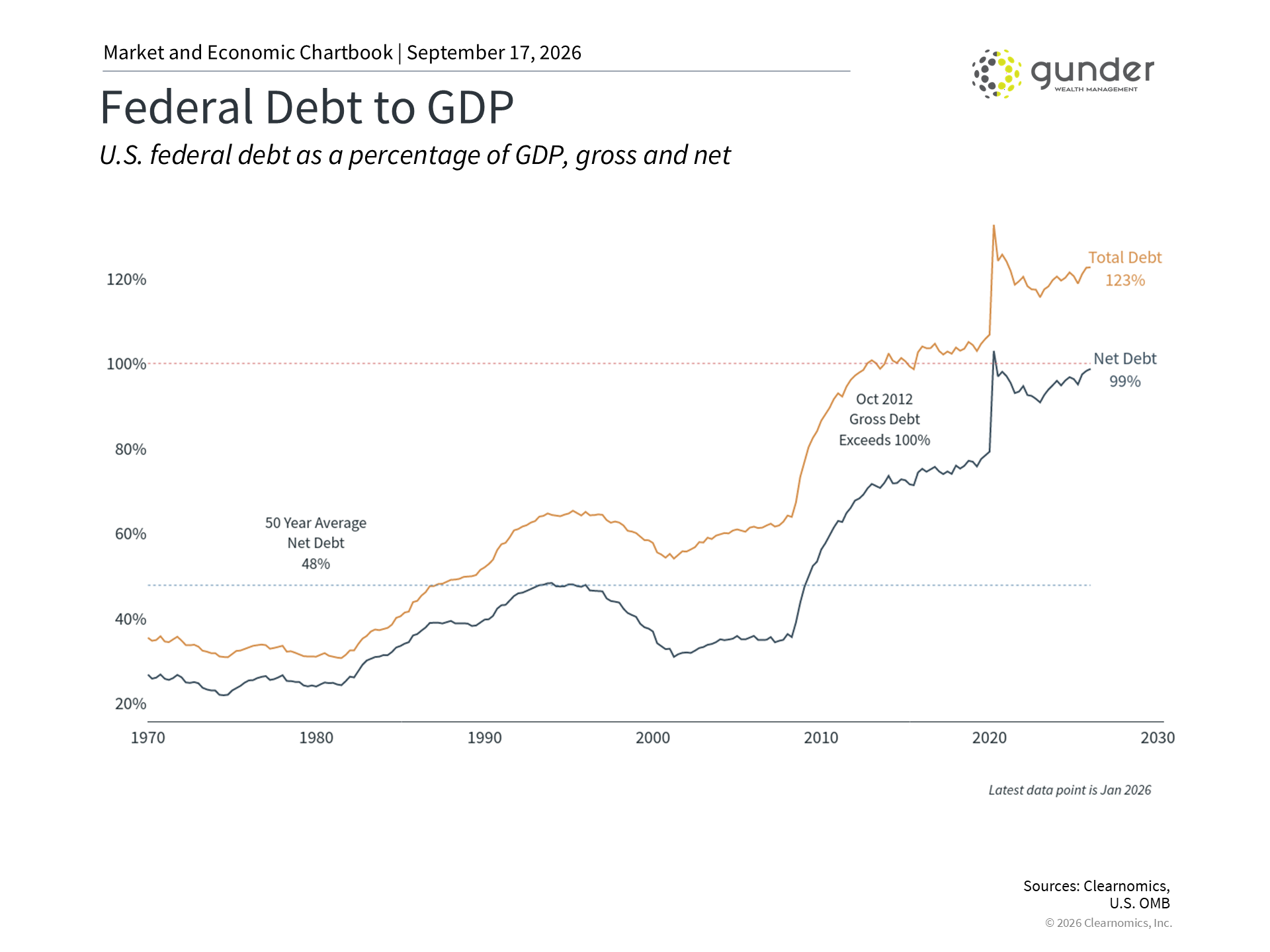
As the chart above shows, U.S. debt has risen significantly relative to GDP over the past several decades. Net federal debt is now roughly equal to annual U.S. economic output, compared with a 50-year average of approximately 48%.
And current projections don’t show that trend reversing anytime soon.
The Congressional Budget Office (“CBO”) projects public debt to rise from approximately 101% of GDP in 2026 to 120% by 2036. At the same time, net interest payments on that debt are projected to increase from 3.3% of GDP to 4.6%.
The deficit matters, too.
The concern isn’t simply that the U.S. runs a budget deficit. It usually does.
A deficit simply means the federal government spends more in a given year than it collects in revenue. Each year’s deficit then adds to the accumulated national debt.
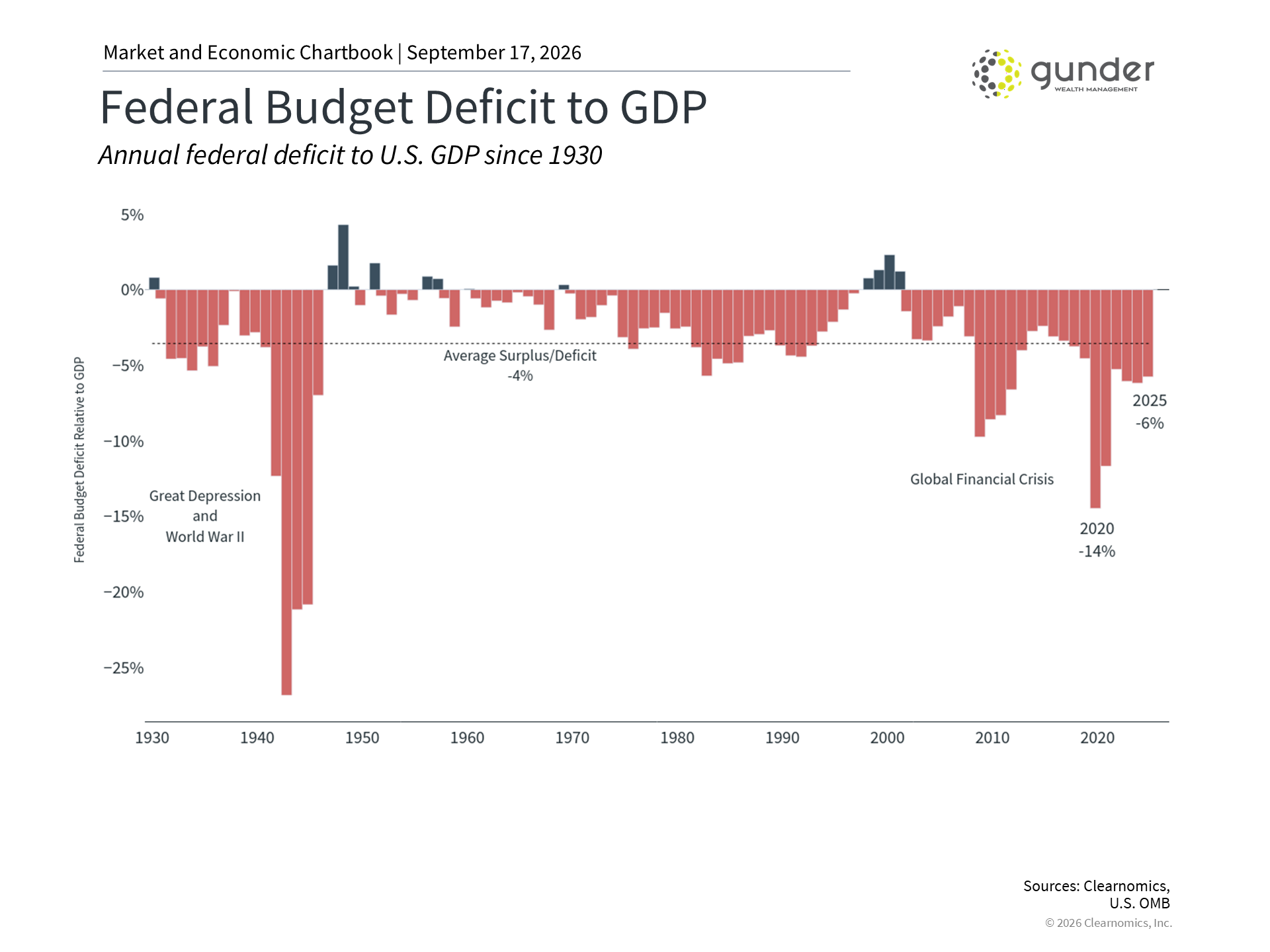
Deficits have occurred throughout modern U.S. history—including during periods of strong economic and market growth. They also tend to increase dramatically during recessions and crises, when tax revenues decline and government spending increases.
What’s unusual today is the size and persistence of the deficit outside of a major economic crisis.
CBO’s February baseline projected a 2026 deficit equal to 5.8% of GDP, compared with an average of 3.8% over the past 50 years. It also noted that deficits of today’s projected magnitude are historically unusual when unemployment remains relatively low.
Recent tariff refunds have added another wrinkle. Following changes in tariff policy and the Supreme Court’s decision regarding certain tariffs, CBO increased its estimate of the 2026 deficit from $1.9 trillion to $2.1 trillion. Through August, the deficit had already reached approximately $2 trillion.
But tariffs aren’t the underlying story. The debt trajectory has been building for decades.
So…should investors be worried?
Concerned? Yes. Panicked? No.
The United States remains an enormous, productive economy, and neither the national debt nor the deficit tells us when—or exactly how—fiscal challenges will affect financial markets.
In fact, markets have performed well during many periods of rising debt and federal deficits. That’s important.
We don’t believe federal debt is a reason to abandon U.S. stocks, make a giant bet against the dollar, or try to predict when the market will suddenly decide the debt matters.
But we don’t think ignoring the issue makes sense, either.
Persistent deficits and rising debt create real economic tradeoffs. As more government resources are devoted to servicing existing debt, borrowing costs can affect businesses and consumers as well. Higher interest costs themselves contribute to future deficits.
There is a flip side for investors: higher interest rates also mean bonds can generate considerably more income than they did during the ultra-low-rate environment of the past decade. The investment implications aren’t black and white.
What does this mean for your portfolio?
Probably less than the headlines suggest—and more than simply ignoring the issue altogether. For us, it comes back to diversification.
But diversification today means more than owning U.S. and international stocks. Or large companies and small companies. Or even stocks and bonds. Those things still matter. But we increasingly think about diversification more broadly.
Depending on the investor, that can include exposure to commodities, natural resources, real estate and infrastructure. For qualified investors, where appropriate, that toolkit can extend into private markets, including real estate, farmland, private equity, private credit and other specialized assets.
We also believe there is room for targeted exposure to long-term economic themes that traditional broad-market allocations may not fully capture.
None of these investments is a magic hedge against federal debt. That’s an important distinction.
The goal isn’t to find the investment that “wins” if America’s debt problem gets worse. It’s to own different investments that respond differently to different economic environments.
We don’t need to predict the ending.
Maybe economic growth surprises to the upside and makes the debt burden more manageable. Or, maybe persistent deficits and higher interest costs create a more challenging environment. Alternatively, what if inflation remains stubborn? What if rates stay higher for longer? Maybe none of those things unfold quite the way anyone expects.
We don’t need to make one enormous bet on any of those outcomes. Our job is to build portfolios that don’t require us to know the answer.
The world changes. Good diversification should change with it.
If you think talking through your portfolio’s diversification would ease your concerns surrounding the mounting U.S. debt, connect with us today to discuss your specific circumstances.
This material is provided for educational purposes only and should not be considered individualized tax, legal, or investment advice. Tax laws and regulations are subject to change. Please consult with your financial advisor, legal professional, and/or tax professional to determine the suitability of these strategies. All views, expressions, and opinions in this communication are subject to change. This communication is not an offer or solicitation to buy, hold, or sell any financial instrument or investment advisory services.