

Bored with bonds? Most people are.
But we’d argue you shouldn’t be. Because while bonds may seem simple, the way you invest in them is anything but.
Most investors assume owning individual bonds is the “safer” or more predictable way to invest in fixed income. It sounds intuitive: you lend money, collect interest, and get your principal back at maturity.
So a question we hear all the time is:
“Why don’t you just buy individual bonds for me?”
The answer is that, for most retail investors, the bond market doesn’t work the way it appears on the surface.
Unlike stocks, bonds trade in a fragmented, over-the-counter market where pricing is far less transparent—and often far less favorable for individual investors. Without institutional scale, access, and expertise, investors can face higher costs, less diversification, and more complexity than they realize.
That’s why we typically use actively managed bond ETFs in portfolios. They provide institutional pricing, professional management, and broad diversification in ways that are difficult to replicate with individual bonds.
What Actually Matters
At a high level, the differences come down to three things:
- Pricing efficiency (what you actually pay)
- Structure (how the investment behaves over time)
- Diversification (how much risk you’re taking)
Here’s how the three approaches compare:
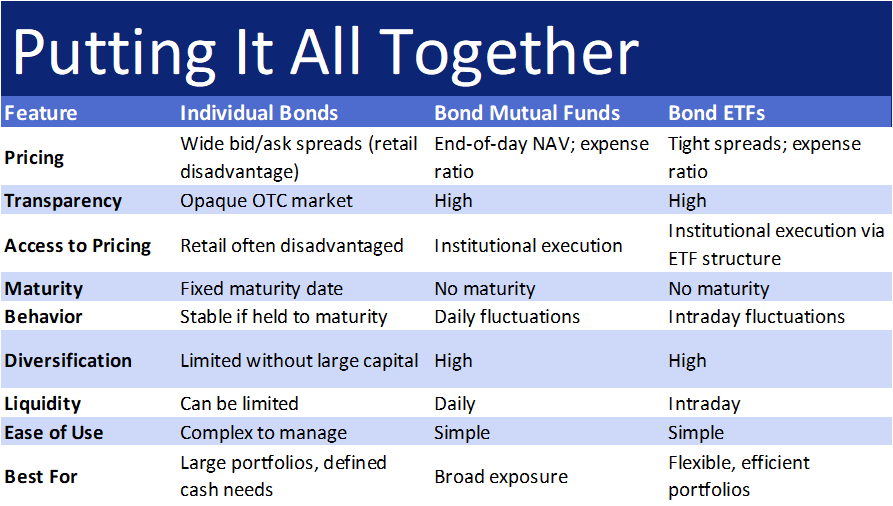
Execution Cost – What Is It & Why Does It Matter?
The biggest difference between actively managed bond ETFs and individual bonds is something most investors don’t see—execution cost.
Individual bonds trade in a dealer market, where prices vary, and spreads can be wide for retail investors. That means two investors can buy the same bond at meaningfully different prices.
Institutional investors—large asset managers, ETFs, and funds—transact at better pricing because of their scale and access.
That gap matters. Over time, these small pricing inefficiencies can quietly reduce returns.
ETFs, on the other hand, benefit from:
- Institutional trading access
- Competition between market makers
- Transparent, exchange-based pricing
This generally leads to more efficient execution and lower friction for investors.
Final Thoughts
There’s no universally “better” option—only what best fits your goals.
Consider individual bonds if you:
- Want predictable cash flows and a known maturity value
- Plan to hold to maturity
- Have the scale and access to transact efficiently
Consider bond mutual funds or ETFs if you:
- Want diversification and simplicity
- Prefer liquidity and transparent pricing
- Value professional management and efficient execution
Our Approach
For most clients, we believe the advantages of actively managed bond ETFs—including institutional pricing, diversification, and flexibility—outweigh the perceived benefits of owning individual bonds directly.
In fixed income, small inefficiencies can compound over time. And for many investors, the hidden costs and complexity of individual bonds make them less effective than they appear.
Because in the bond market, how you access it matters just as much as what you own.
If you’re interested in constructing a ladder or a series of maturity-dated bonds to specifically support cash flow planning, we’re happy to discuss that strategy in greater detail. Connect with us today to construct a fixed income portfolio that’s best suited for you.
Please consult with your financial advisor and/or tax professional to determine the suitability of these strategies. All views, expressions, and opinions in this communication are subject to change. This communication is not an offer or solicitation to buy, hold, or sell any financial instrument or investment advisory services.